What Physical-Competition Training Kit Is Built For: Grip, Water, Camera, Heat
Disclosure: Bubblelime (bubblelime.com) is an activewear store connected to this site's publisher. Treat mentions of it on this page as promotional. How we make this.
- Physical-competition wardrobes are chosen for four constraints: grip, water, camera and heat.
- Special Forces season 5 returned Sept. 24 at 9 p.m. ET on FOX, which put cold-and-wet field kit back on screen for the first time this fall.
- Everything below is about garment function. We do not name what any individual wore unless a brand or network published it.
The gist — The clothing on a physical-competition show is doing four jobs: staying put on a rig, drying after water, reading cleanly on camera, and not cooking the wearer. Those four constraints explain nearly every wardrobe choice you notice, and they are the same constraints a gym does not impose.
Watch an obstacle course with the sound off and you can predict the wardrobe before the competitor moves. Long sleeves mean rope. Dark colors mean water. A short inseam means heat.
What does a rig or rope event demand?
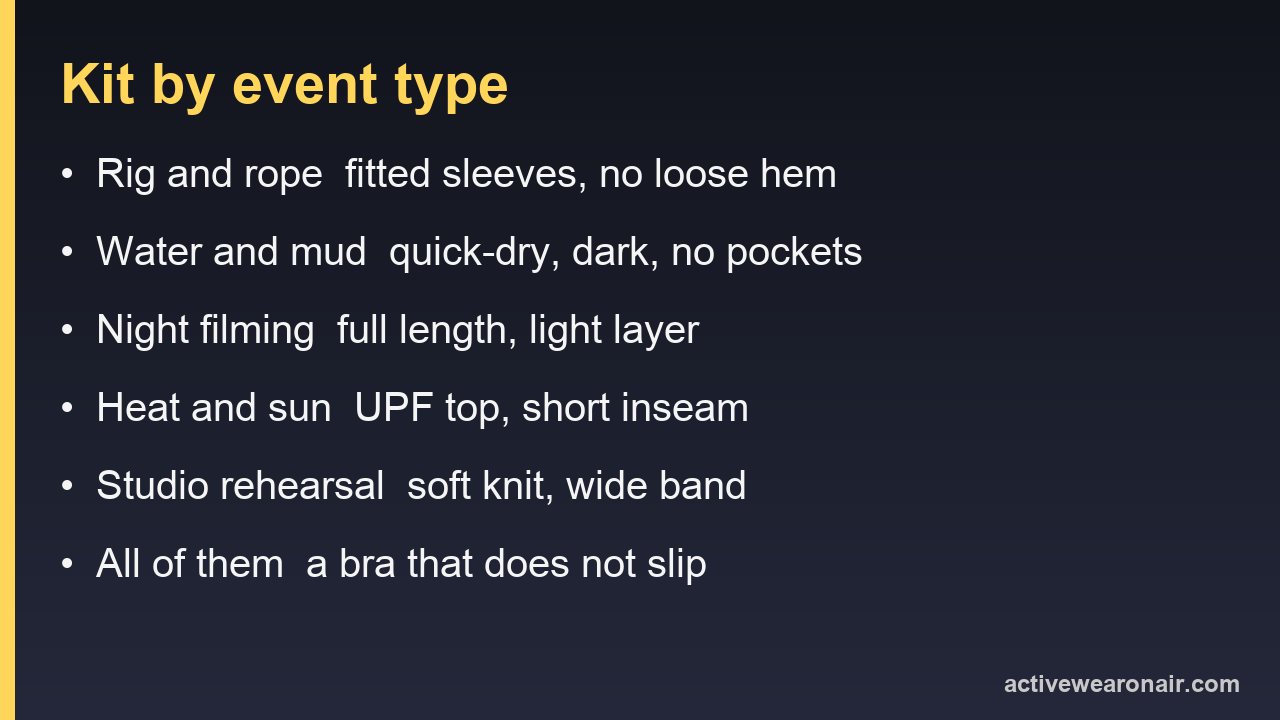
Fitted everything, and nothing that hangs. A loose hem catches on a ring, a drawstring loop snags on a peg board, and a sleeve that slides down costs grip on a rope descent.
Full-length compression bottoms show up constantly on rig events for a reason unrelated to warmth: bare skin sticks to painted steel and rubber, and a fabric layer lets the leg slide across an obstacle instead of grabbing at it.
👉 If you are copying the look for your own gym: the detail that matters is the waistband, not the fabric name. Four inches or wider stays put through inversion.What changes when there is water?
Weight and color. A cotton-blend top that takes on two pounds of water is a liability, so the wardrobe skews to nylon-spandex knits that shed it. Pockets get avoided, since a pocket is a bucket.
Dark colors dominate wet events because wet light fabric goes transparent on camera. The same reason drives the opacity question in ordinary shopping — our sister site covers how to test it in the fit guide.
How does the camera change the clothing?
- Small repeating patterns are avoided. Fine stripes and tight checks strobe on camera.
- Pure white is rare. It clips under stadium lighting and makes exposure harder.
- Logos get covered or turned. Unlicensed branding is a clearance problem for the production, not a style choice.
- Color separation matters. Two competitors in the same shot need to be distinguishable at a glance, which is why teams end up in blocks of color.
What holds up in heat and long shoot days?
Shoot days run long, and the wardrobe has to survive standing around as much as competing. Sun-protective tops with a stated UPF rating appear often on outdoor productions, along with shorter inseams and lighter knits.
The unglamorous truth is that most of what you see is chosen for a 12-hour day in the sun rather than for the 90 seconds of competition. That is also why the same items reappear across episodes.
What can you actually buy, and for how much?
Prices below were read from each seller's own page on the morning of Sept. 8, 2026. These are the closest buyable equivalents by construction, not claims about anyone's wardrobe.
| Piece | What to look for | Price band checked Sept. 8 |
|---|---|---|
| Full-length compression legging | 4"+ waistband, flat seams, opaque dark knit | $17–$41 |
| High-support bra | Racerback or crossback, no slipping strap | $15–$25 |
| Fitted training top | Quick-dry knit, hem that stays down | $10–$16 |
| Short-inseam short | 3" to 7", inner brief, no external pocket for water events | $9–$35 |
A full kit at the low end lands around $51. At the upper end of the same silhouettes it is closer to $200, and the difference is fabric weight, size range and how many washes it survives.
What we will not tell you
Which brand any individual competitor wore, unless the brand or the network said so publicly. Wardrobe here mixes personal clothing, production-supplied gear and sponsor product, and the on-screen evidence rarely separates the three. Guessing a logo from a compressed broadcast frame is how bad shopping advice gets made.
The method we use instead — identifying garments by construction and matching them to what is buyable — is in how to find the workout clothes you see on TV.
Do competitors choose their own clothes?
It varies by production, and the specifics are usually not published. Some shows issue uniform pieces for team identification; others let competitors bring their own within rules. We only describe what is visible.
Why do the same colors keep coming back?
Camera legibility plus laundry. Dark neutrals photograph consistently, hide dirt through a long shoot, and let editors cut between takes without a wardrobe mismatch.
Is expensive gear actually better for this?
For repeated washing and a full size run, often yes. For 90 seconds on a rig, a $20 legging with a wide band does the same job — see the current price spread at Activewear Deals.
TL;DR — Grip, water, camera, heat. Fitted sleeves and hems for rigs, quick-dry dark knits for water, no fine patterns for camera, UPF and short inseams for sun. A functional equivalent kit costs about $51 at the low end. Special Forces brought the wet-and-cold version back Sept. 24.
What about shoes?
Shoes are the hardest item on screen to chase and the easiest to get wrong. Footwear is the most heavily sponsored category on competition television, so what you see is often a current-season model that will be replaced before the season ends, and fit is the least transferable part of it — two people in the same size land on different models depending on arch, width and how they load the foot. What does transfer is the category.
| Event type | What the shoe has to do |
|---|---|
| Rig and obstacle | Flat, thin-soled trainer that lets the foot wrap a bar or a ledge. |
| Water events | Something that drains and stays on. |
| Kitchen shows (Hell's Kitchen season 25 premiered Sept. 24, 8 p.m. ET on FOX) | Closed, slip-resistant shoe that survives eight hours on a tile floor — a genuinely different product from a training shoe. |
Copy the category, ignore the model — the on-screen look lives in the clothing, covered in shop the look and our guides.
Sources
- Premiere dates: network listings via TVmaze, retrieved Sept. 8, 2026.
- Price bands: product pages at bubblelime.com, senitaathletics.com and popflexactive.com, read Sept. 8, 2026.
- Sizing reference: Legging Size Guide.
- What to Wear for a Mud Run: What Special Forces Season 5 Gets Right
- Special Forces Season 5 (2026): What the Recruits Wear, the Cast and the Episode Schedule
- What Do Physical 100: Mexico Contestants Wear? Dark Sleeveless Tops, Grip Gloves and a Stone Arena
- What Do Physical 100: Italy Contestants Wear? The White Tee, the Shoulder Number and the Plank Over Water