Why Do Competition Shows Color-Code Their Casts? Buffs, Brigades and the Camera
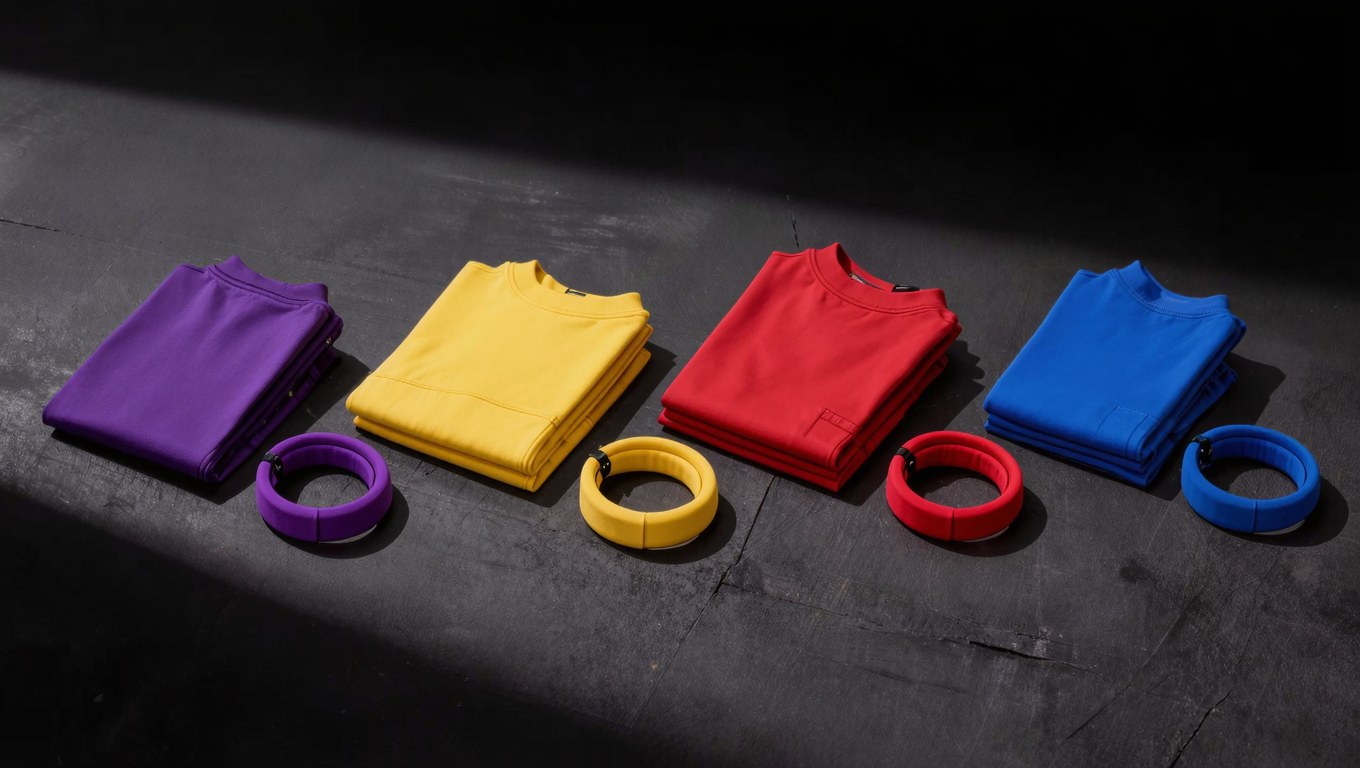
Turn on any competition show and the wardrobe tells you the score before the host does. One side is red, the other is blue. A tribe is yellow, the tribe across the water is purple. It is the oldest trick in unscripted television, and it is also the reason a lot of people end up searching for a plain purple tank top in September.
So here is the part nobody explains on air: which of these colors are issued by production, which are chosen by the cast, and what that means if you want to buy something similar.
Why do competition shows put their casts in colors at all?
Because an edit has to be readable at a glance. A challenge runs long, gets cut down to eight minutes, and jumps between six camera positions. If viewers have to identify people by face in a wide shot, the sequence falls apart. Color solves it instantly — you can follow a race from across the room with the sound off.
The second reason is practical. Teams get reshuffled, merged and dissolved constantly, so the show needs a signal it can hand out and take back in one motion. A buff or a jacket does that. A face cannot be reassigned on day 12.
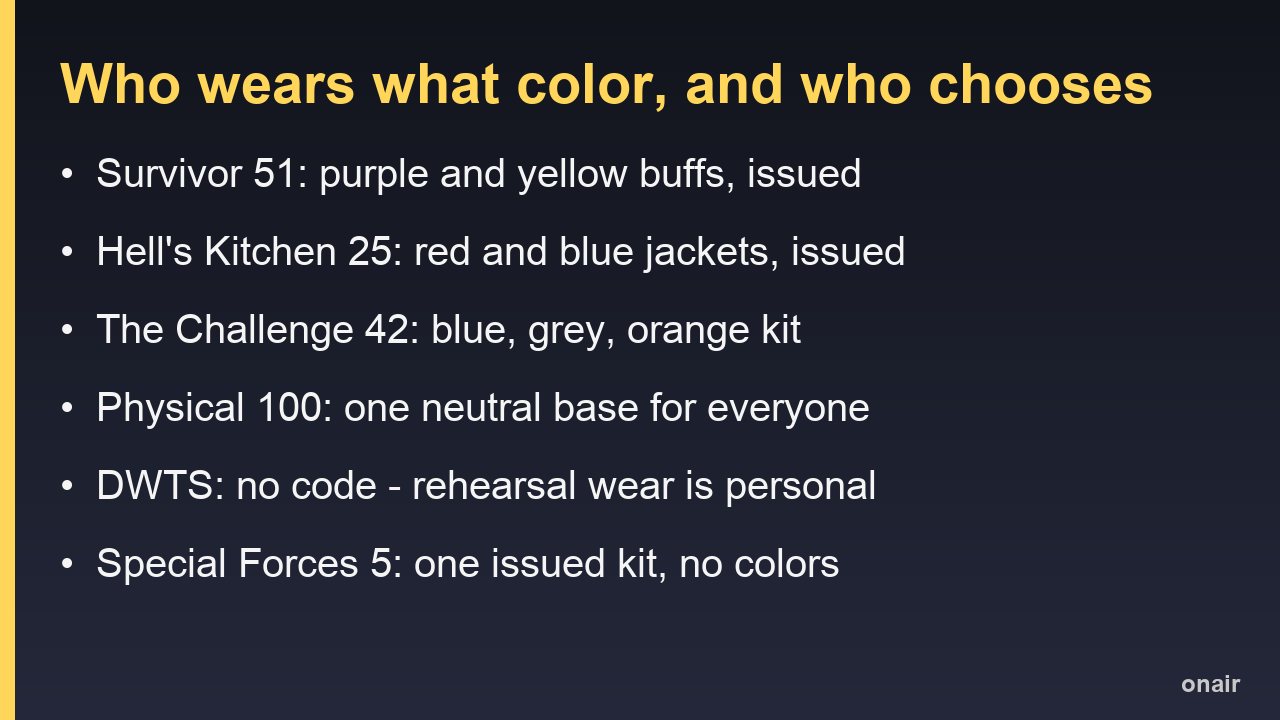
| Show | Colors this fall | Issued or personal? | What the cast picks |
|---|---|---|---|
| Survivor 51 | Purple, yellow | Buff is issued | Everything else, inside a rule sheet |
| Hell’s Kitchen 25 | Red, blue | Jacket is issued | Shoes and whatever goes underneath |
| The Challenge 42 | Blue, grey, orange | Competition kit is issued | Base layers, sports bras |
| Special Forces 5 | None — one kit | Fully issued | Nothing |
| Physical 100 editions | One look for all | Issued, numbered | Shoes, tape, grip |
| DWTS 35 rehearsal | None | Personal | All of it |
What is a Survivor buff, and who chooses the color?
The buff is the only garment the show hands every player, and it has been the tribe marker since the first season. It is a seamless tube of stretch fabric that works as a headband, a wristband, a bandana or a bag tie, which is why it survives 26 days in Fiji when nothing else does.
Production picks the colors, and they are deliberately far apart on camera. Season 51 runs purple against yellow — 10 players in one, 11 in the other, the first cast in the show’s history to start on an odd number. Back in the Australian Outback it was green for Ogakor and blue for Kucha, solid blocks with no pattern. The designs got busier over the years; the job never changed.
What the players wear underneath is their own, chosen weeks before the flight and cleared by the show. Our tribe-color breakdown goes through the approval list and the reported no list, including why quick-dry athletic fabric is harder to get past production than you would guess.
Why are kitchen and arena teams split into two or three?
Because the format needs a losing side. Hell’s Kitchen puts 18 chefs into red and blue, divided by gender this season, and the jackets are the uniform from the pass to the dorm. The only wardrobe decisions left belong to the chef: the shoes, and the layer under the whites in a room that hot. We went through both, because a clog choice is a twelve-hour decision.
The Challenge goes to three colors and treats them as competition kit rather than costume — harnesses go over the top, so seam placement stops being about looks. The arena kit page covers what that does to the base layer.
Which shows skip the color code entirely?
Individual competitions, mostly. Special Forces issues one kit to all 15 recruits and runs them through a Malaysian jungle in it; there are no teams to tell apart, and the wardrobe story is what water and mud do to the fabric over days rather than who is wearing what. The season 5 kit page has the premiere details.
Physical 100 does something in between: a single look for everyone with a number on the shoulder, so the contrast is between bodies instead of between teams. That is a deliberate choice, and it reads very differently in the Italian edition than in the Mexican one. American Ninja Warrior never coded anybody, because one person runs at a time — the sleeve and grip question is the whole wardrobe argument there.
And then there is the rehearsal room, which is the purest case. Nobody assigns a ballroom pro a color at 9 a.m. on a Tuesday. What they wear is what they own.
Does a bright color change what the garment is made of?
It changes how it behaves on screen more than how it is built. Saturated dyes sit differently on nylon than on polyester, and a solid bright color shows sweat as a dark patch within minutes, which is why you rarely see a pale solid on a challenge that involves water. Black hides sweat and shows salt instead — anyone who has finished a long run in a black top knows the white tidemark that comes with it.
Stretch is the other half. A heavily dyed knit can feel stiffer out of the bag and loosens after a few wears, so the fabric matters as much as the shade; the nylon-versus-polyester comparison on our sizing site is the short version of that.
How do you wear one of these colors without looking like a contestant?
One block, not two. A purple tank with black leggings reads as a color choice. A purple tank with purple leggings and a purple headband reads as a uniform, and it is the single thing that separates a screen look from a wearable one.
Match the finish rather than the exact shade. Screen colors are lit, graded and shot on fabric that was chosen to survive, so chasing the precise tone on your monitor is a losing game. Read the construction instead — the rise, the strap, where the seams land, how long the inseam looks against the knee. That method gets you closer than a brand hunt, and the grip-water-heat version of the argument sits in the training kit page.
What is color-coded this week, and what is not?
Wednesday is the loud one: 21 players, two buffs, two hours on CBS. Thursday stacks the opposites back to back — the reddest, bluest hour on television at 8, then an hour at 9 where everyone is dressed identically in whatever the jungle has done to it.
Tuesday is the one to watch if you actually want to dress like this. Week two of DWTS is Viral Hits Night, and the rehearsal packages are where the copyable clothes live: high-waisted flares, a fitted tank, socks over the shoe. The ballroom costume is a different craft altogether, and our sister site handles how those are built. The rehearsal side stays here, along with the shoe question. The rest of the week is laid out in our night-by-night grid, and older breakdowns sit under Competition Shows, Fitness Shows and Shop the Look.
TL;DR
| Who assigns the color | Production, almost always — a buff, a jacket or a kit that can be reassigned overnight. |
|---|---|
| Why | So a wide shot reads instantly, and so teams can be broken up without confusing the edit. |
| What the cast controls | Base layers, sports bras, shoes — the parts you can actually copy. |
| Shows with no code | Special Forces, Physical 100 editions, American Ninja Warrior, DWTS rehearsal. |
| Wearing it yourself | One block of color, not head to toe. Match the finish, not the exact shade. |
Sources
- Survivor 51 premiere date, Fiji location, 21 castaways and the odd-numbered cast: Wikipedia; purple and yellow buff split reported by Yahoo Entertainment.
- Buffs as the tribe marker since season one, and the Ogakor green / Kucha blue split: Survivor Wiki and Wikipedia.
- Hell’s Kitchen season 25 premiere, 18 chefs aged 25 and under, red and blue teams: TV Insider.
- Special Forces season 5 premiere time, Malaysia setting and 15 recruits: TV Insider.
- DWTS season 35 week two date and Viral Hits theme: Parade. All times checked Sept. 22, 2026, 12:40 a.m. ET.